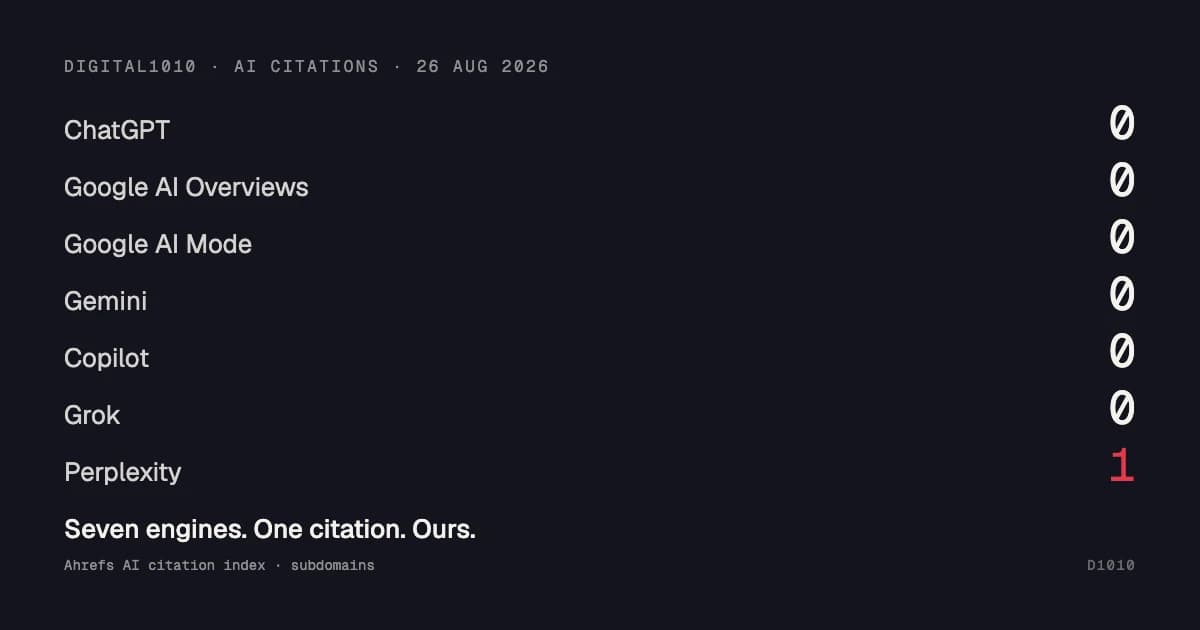
Seven AI engines. One citation.
That is our domain, measured with the same audit we run for clients.
| Platform | Citations | Cited pages |
|---|---|---|
| ChatGPT | 0 | 0 |
| Google AI Overviews | 0 | 0 |
| Google AI Mode | 0 | 0 |
| Gemini | 0 | 0 |
| Copilot | 0 | 0 |
| Grok | 0 | 0 |
| Perplexity | 1 | 1 |
Source: Ahrefs AI citation index, digital1010.com, subdomains mode, all platforms. Measured 18 August 2026 and re-verified 27 August — unchanged.
One citation. On one platform. Out of seven.
I am publishing this because the alternative was worse. Our services page says we track citations in ChatGPT, Claude, Perplexity and AI Overviews. That sentence is true about the work we do. It was sitting on a domain that six of those engines had never referenced. A prospect who checked would have been the wrong person to find that first.
The reason this matters to you rather than to us is the thing the audit turned up next, and it took a while to accept:
The engines are not reading your site to decide who to recommend. They are reading everyone else's.
Which means your own number is probably not what you assume, and almost nobody reading this has checked. If you have spent two years making your site excellent and you are not in the sources those engines pull from, you can be the best-optimised invisible company in your category.
Here is how ours got that way.
The benchmark makes it worse
The obvious defence is that nobody gets cited much yet. So I measured a competitor — an MSP marketing agency that holds position three on "msp marketing agency" and gets referenced twice inside that query's AI Overview.
| Platform | Their citations |
|---|---|
| ChatGPT | 2 |
| Perplexity | 2 |
| Google AI Overviews | 4 |
| Google AI Mode | 2 |
| Gemini | 2 |
| Copilot | 5 |
| Grok | 2 |
Measured 18 August 2026.
Cited on all seven. We were on one.
It is not a website problem, and that is the useful part
The reflex is to blame the site. Add schema, tighten the headings, fix the crawlability. We had already done most of that.
There is an authority gap — our domain rated 36 against their 54. That gap is real and it explains ranking differences. What it does not explain is zero on six platforms. A rating of 36 is not a rating of 4. Sites far weaker than ours get cited every day.
The mechanism is the one stated at the top, and it is worth restating now that the authority explanation is off the table: the engines are reading everyone else's site, not yours.
When someone asks ChatGPT for the best agency in a category, the answer is assembled largely from third-party sources — roundups, directories, comparison posts, forum threads, review sites. Being excellent on your own domain is not the qualifying condition. Being present in the corpus those engines draw from is.
And that corpus is not the same one Google ranks. We measured queries where we hold a respectable organic position and are absent from the AI answer covering the same question. Ranking and citation are two different distribution channels that happen to share a search box.
The industry is surveying itself
While I was working through this, NP Digital published a study on which content types earn the most AI citations. Listicles and roundups came out on top at 21.87%, articles at 16.68%, comparison and alternative pages last at 2.5%.
Read the methodology, though. It is 1,000 marketers surveyed, and the study says plainly that it reflects "practitioner-reported citation distribution rather than a controlled analysis of actual AI citation behavior."
That is not a criticism of the research — it is transparent about what it is, and the directional read is useful. It is a description of where the whole category currently sits. We are asking marketers what they think is happening inside AI engines, because measuring what is actually happening is harder and almost nobody has instrumented it.
The gap between those two things is the entire opportunity.
What measurement actually looks like
Two things changed how we think about this.
First, per-platform, not blended. A single AI visibility score would have told us "1" and hidden the fact that six engines had never seen us. The distribution is the finding. We wrote up the method for measuring across platforms separately in measuring AEO visibility across four platforms.
Second, the analytics side is finally catching up. GA4 now reports an AI Assistant channel. Across our last 90 days — 28 May to 25 August 2026 — it delivered 7 sessions at a 57% engagement rate. That is the second-highest engagement rate of any channel on the site, above paid social, and more than three times our direct traffic.
Tiny volume. Excellent quality. Which is exactly the profile you would expect from someone arriving after an AI engine has already answered their question and recommended you. They are not browsing. They have been pre-qualified by the machine.
Report that as a directional signal rather than a trend — the sample is small. But it is measured, first-party, and it is more than a survey response.
What we are doing about it
The work is not finished, so this is what is underway rather than what was learned:
- Getting into the third-party corpus. Not link building. Presence in the roundups, comparison posts and directories the engines actually pull from. This is the lever, and it is the slowest one.
- Building comparison pages. The NP Digital data puts comparison and alternative pages last at 2.5% — and their own reading is that this reflects scarcity rather than underperformance. Comparison queries are among the highest-intent things anyone asks an AI engine. Almost nobody is building for them.
- Measuring per platform, monthly, and writing the number down even when it is one.
If you want the background on how AEO and classical SEO differ mechanically, we covered that in AEO vs SEO and in how AI Overviews changed WordPress SEO. What our AEO engagements actually involve is on the answer engine optimization services page.
The question to ask any agency pitching you on AI visibility
Ask for their own number. Per platform. With the date it was measured.
Not their client results — their own domain, the seven engines, the date. It is a thirty-second question and it separates the firms that have built the measurement from the firms that have built a slide about it. Most cannot answer it, and the ones who deflect to case studies are telling you something.
Ours is one, measured 27 August 2026, and now you have seen the table.
Two things worth being straight about. If AI visibility is an idea you find interesting rather than a channel you are being judged on, none of this is urgent and you should spend the quarter elsewhere. This matters when you are already spending real money on being found, when a customer is worth enough that being absent from a recommendation costs something you can calculate, and when somebody senior is going to ask where those numbers come from.
And if that is you, the honest first move is not hiring anyone. It is finding out where you actually stand.
Run the free AI readiness scan → It checks the same things this audit did, on your domain, in about a minute. It is free because it is also how we decide whether there is anything here worth working on — for a good number of the domains we run it against, the answer is no, and we would rather find that out in sixty seconds than on a call.