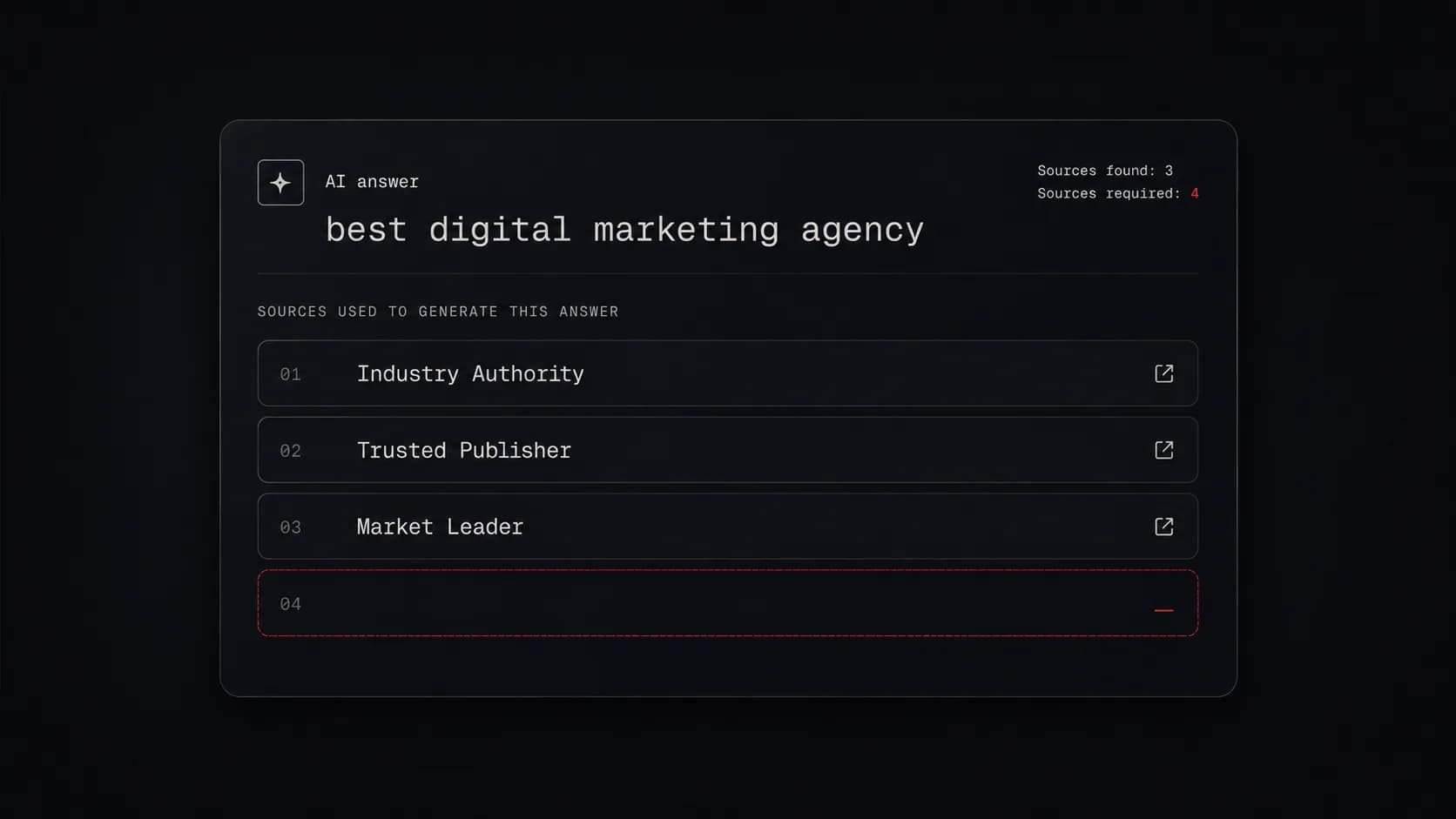
There is now a machine deciding who exists in your market, and no Google ranking changes its mind.
A prospect called us last quarter because a competitor he had never heard of kept coming up when he asked ChatGPT for the best provider in his category. He was ranking fine on Google: clean site, decent backlink profile, an agency sending him monthly SEO reports. None of it explained why the machine his buyers were now asking did not seem to know he existed. The engines had settled on a short list they trusted for "best in this category," and his brand was not on it. That is the problem SEO cannot reach, because it is not a Google problem.
Closing that gap is what answer engine optimization services are supposed to do. The trouble is the label got popular faster than the discipline, so a lot of what gets sold as AEO today is a schema-markup pass and a blog cadence with a new cover page. This is what a real engagement actually includes, how it is scoped, and the questions that separate an AEO agency from a rebrand. If you would rather just see where your brand stands before reading further, the free AEO Visibility Scan checks your domain across all four engines in a few minutes. The rest of this is what to do about the result.
What "answer engine optimization services" actually means
Answer engine optimization is the practice of making a brand the source that AI answer engines cite when someone asks them a question. The answer engines that matter right now are ChatGPT, Claude, Perplexity, and Google AI Overviews. Unlike traditional search, which returns a list of links for the user to choose from, an answer engine synthesizes a single response from sources it has decided to trust. AEO is the work of becoming one of those trusted sources.
That is a different job from SEO, and it is worth being precise about why, because the difference is exactly where rebranded packages fall short. SEO optimizes individual pages to rank for keywords. AEO builds entity-level authority so the model understands who you are, what you do, and why you are a credible answer, then structures your content so the model can parse and quote it cleanly. Backlinks still matter. Keywords still matter. But they are inputs to a larger goal, not the goal itself. (If you want the full conceptual breakdown of search engines versus answer engines, it is in AEO vs SEO.)
What an AEO engagement actually includes
Here is the operational stack we run. If an agency is selling AEO services and cannot show you work in each of these areas, they are selling you a label.
Entity foundation
Answer engines resolve entities before they answer. Before a model will cite you, it needs a consistent, machine-readable picture of who you are across the web: your name, your category, your locations, your people, your proof. The first layer of any real AEO engagement is auditing and fixing that entity picture, which means structured data, consistent business information everywhere it appears, and clear, unambiguous descriptions of what you do. It is unglamorous, which is exactly why most "AEO packages" skip it and jump straight to publishing content. Skip the entity work and the model never forms a clean read on who you are, so the content has nothing solid to attach to.
Answer-shaped content
Content built for AEO is structured so a model can lift a clean, correct answer out of it. That means question-shaped headings, direct answers stated first and elaborated second, definitions and lists and tables where they fit, and an absence of the throat-clearing that pads most marketing copy. The goal is not to rank a page. The goal is to be the cleanest available source for a specific question, so that when the model assembles an answer, your phrasing is the easiest to quote.
Measurement across the four engines
AEO visibility is genuinely hard to see: every user gets a slightly different answer, and the engines publish no rankings to check. We built our own methodology for this: defined query sets, scored every week across ChatGPT, Claude, Perplexity, and Google AI Overviews, tracking whether you get mentioned, whether you get cited, and how you are positioned when you do. The full build is documented in how we measure AEO visibility across four platforms. The point for a buyer is simple: if your AEO provider cannot show you a visibility number that moves over time, they are guessing.
Citation and source presence
Answer engines lean on a set of sources they trust for each topic: established publications, structured databases, review platforms, and increasingly the brands that have built clear topical authority. Part of an AEO engagement is identifying which sources the engines actually cite in your category and earning presence in them. This overlaps with traditional digital PR and link work, but the targeting is different, because you are optimizing for what the model reads, not for what passes link equity.
Closed-loop tie-back
The last layer is the one almost nobody does: connecting AEO visibility to actual business outcomes. Showing up in ChatGPT is not the goal. Showing up in ChatGPT and having that turn into a qualified lead is the goal. We built our own attribution platform, Orbit, to close that loop: it tracks visibility across the four engines and ties it through to the leads it produces, so the program is measured against pipeline and not against vanity mentions. That is the standard to hold any AEO provider to, whether they use a tool like ours or not: visibility measured against revenue, not against how many times you got mentioned.
How to tell a real AEO agency from a rebranded SEO package
If you are evaluating providers, these are the questions that surface the difference fast. We would answer all of them in a first call, and an honest shop should.
"Show me how you measure AEO visibility." If the answer is a screenshot of a single ChatGPT query, or worse, a promise that they will "optimize for AI," there is no measurement discipline underneath. Ask for the methodology and the cadence. Real AEO produces a number you can watch move.
"What do you do about entities and structured data, not just content?" If the entire answer is about publishing more blog posts, you are buying content marketing with an AEO sticker on it. The entity foundation is where AEO actually diverges from SEO, and it is the first thing a real engagement touches.
"How do you connect AEO visibility to leads?" Most providers cannot answer this at all, because most are not measuring outcomes. You do not necessarily need a platform as built-out as Orbit, but the provider should at least have a theory of how visibility becomes pipeline, and a way to check whether it is happening.
If those three come back thin, the agency is running an SEO retainer and calling it AEO. Different product.
If you are not sure how your current provider would answer any of that, the free AEO Visibility Scan is the fastest way to see what they are actually working with. It runs your domain across all four engines and shows you where you stand in a few minutes.
What AEO services cost, and how it is scoped
We do not publish a fixed package price for AEO, because the right scope depends on the state of your entity foundation and how competitive your category is inside the answer engines. What we can be straight about is the shape of the engagement.
A focused, fixed-scope project makes sense when the problem is bounded: a one-time entity and AEO audit, a structured-data and content remediation pass, a measurement baseline stood up so you can see where you actually are. That is scoped like the rest of our fixed-scope consulting, which starts in the five figures, with a defined deliverable and a defined price set on the first call rather than a number that drifts.
A retainer makes sense when AEO is an ongoing competitive front, which it increasingly is, because the engines re-index constantly and competitors are moving. There, AEO runs alongside SEO and content as one program, priced against the size of the opportunity rather than billed by the hour. The honest test for which one you need is whether you have a bounded problem to fix or a position to defend over time.
How to know if you need AEO now
You need AEO now if AI Overviews already appear for your commercial searches, if your buyers are the kind of people who ask ChatGPT or Perplexity before they shortlist vendors, or if you are already investing in SEO and want to know whether that investment is carrying into the answer engines at all.
Here is the part that makes timing matter. Answer engines are still deciding which sources to trust in most categories, but every week they get more settled, and the brands that built clear entity authority early are the ones getting cited now. Each month a competitor spends being the clean, citable answer in your category is a month that position hardens around them instead of you. The work compounds slowly, which cuts both ways: slow to start paying off, and slow to claw back once someone else owns the answer.
So start with the cheap, fast read. The free AEO Visibility Scan runs your domain across all four engines and emails you a composite score and a gap list in a few minutes. If it confirms a problem worth fixing, talk to Michael and we will scope what closing it actually takes. The scan tells you whether you have a problem. The call tells you what fixing it takes, and whether we are the right shop to do it. Sometimes the answer is that you do not need us, and we will say so.