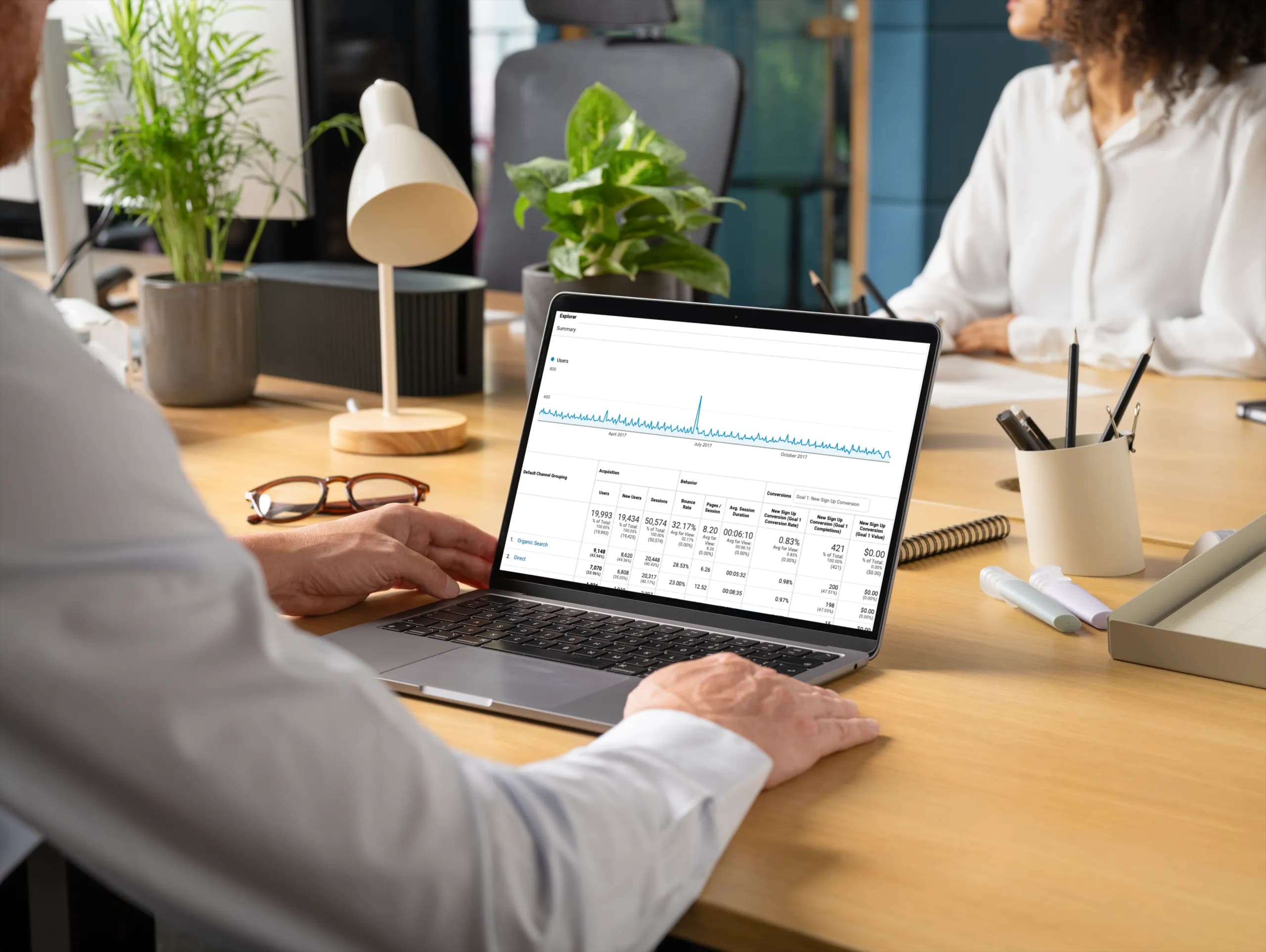
The Traffic Mystery Plaguing WordPress Sites in 2025
Your WordPress site ranks on page one. Your Core Web Vitals are passing. Your content is comprehensive and well optimised. Yet organic traffic is falling anyway, and nothing in your reporting explains why.
If that is your situation, you are not imagining it, and the cause is probably not something you did.
Google's AI Overviews are changing how users interact with search results. Semrush and Datos, analysing more than 10 million keywords, found AI Overviews on 13.14% of US desktop searches in March 2025, up from 6.49% in January, roughly a doubling in two months. The share has kept climbing since, and later Semrush reporting puts it near 16%, so treat any single figure here as a floor rather than a current reading.
The impact on clicks is measurable. Pew Research Center, tracking the browsing of over 900 consenting adults across 68,879 Google queries in March 2025, found users clicked a traditional search result on 8% of visits where an AI summary appeared, against 15% where one did not. They clicked a link inside the summary itself on 1% of visits. They also ended the browsing session entirely on 26% of pages carrying an AI summary, against 16% without.
For WordPress site owners who've invested heavily in SEO, this represents a paradigm shift that requires an immediate strategic response.
Understanding Google's AI Overviews: What Changed and When
Google's AI Overviews, formerly known as Search Generative Experience (SGE), began rolling out to all U.S. users in May 2024. By 2025, the feature expanded to over 200 countries and 40 languages.
What AI Overviews Actually Are:
When triggered by specific queries, AI Overviews appear as a prominent box at the top of search results, displaying:
- Multi-paragraph AI-generated summary synthesizing content from across the web
- Links to source websites (though not always to top-ranking pages)
- Suggested follow-up questions
- Expandable sections for additional context
Early analysis suggested AI Overview citations tracked organic rankings closely. seoClarity's study of 36,000 keywords put the overlap with the top 10 web results around 90%.
That relationship has since weakened badly, and this is the part worth updating your assumptions on. More recent analyses put the share of AI Overview citations coming from top-10 pages far lower, with some measurements in the 38% to 52% range. Ranking in the top 10 is no longer close to sufficient for citation, and treating it as a proxy will cause you to over-invest in position and under-invest in being quotable.
The Traffic Impact By Query Type:
Not all searches experience equal disruption, and the mix has moved fast. Semrush's tracking shows informational queries dominated early, accounting for over 90% of AI Overview triggers in January 2025, then falling to roughly 57% by October as Google pushed the feature into commercial, transactional and navigational intent:
- Informational queries: still the largest share, but a shrinking one
- Commercial queries: rose from roughly 8% to 19% over 2025
- Transactional queries: rose from around 2% to 14%
- Navigational queries: went from under 1% to over 10%
The direction matters more than any single number. The feature is moving toward the queries that convert.
The nature of content also matters. Healthcare, personal finance, education, and technology sectors, where informational content dominates, experience the most significant impact.
The Zero-Click Search Reality: What the Data Actually Shows
Similarweb reports zero-click searches, meaning searches ending without any click on the SERP, rose from 56% to 69% between May 2024 and May 2025, a 13 point move that tracks the AI Overviews rollout. While this captures trends beyond just AI Overviews, the timing aligns directly with the feature's expansion.
The Visibility Problem:
Advanced Web Ranking found that AI Overviews average approximately 169 words and include about seven links when expanded. Once expanded, the first traditional organic result often appears roughly 1,674 pixels down the page, well below the fold on most devices.
This creates a fundamental challenge: ranking #1 no longer guarantees visibility or clicks when AI Overviews dominate the visible SERP real estate.
The Citation Paradox:
The nuance that survives from the early seoClarity work, and that still holds up: citation is not a reward for being first. Their data showed AI Overviews frequently linking to pages in the top few positions while linking to the actual number one result far less often than you would expect. Being cited is a different competition from ranking, and it is decided by whether a passage answers the question cleanly enough to lift.
This breaks the long-standing correlation between search position and traffic potential, requiring entirely new strategic approaches to organic visibility.
Why WordPress Sites Face Unique AI Overview Challenges
WordPress powers approximately 43% of all websites globally, making these AI-driven changes particularly impactful for the CMS ecosystem. However, WordPress sites face specific technical challenges that impact their AI performance overview.
Core Web Vitals Performance Gap:
HTTP Archive's Core Web Vitals Technology Report, which tracks this continuously rather than as a one-off study, has WordPress passing rates sitting in the high thirties to low forties percent, with mobile trailing desktop. Check the live figure rather than quoting this sentence, because it moves. This performance gap matters because Google's AI systems prioritize fast-loading, technically sound websites when selecting content to feature.
The three Core Web Vitals metrics, Largest Contentful Paint (LCP), Interaction to Next Paint (INP), and Cumulative Layout Shift (CLS), directly impact whether content gets selected for AI Overview citations:
- LCP under 2.5 seconds: Indicates fast loading of main content
- INP under 200 milliseconds: Shows responsive interactivity
- CLS under 0.1: Demonstrates visual stability
WordPress sites that fail these thresholds face a reduced likelihood of AI Overview inclusion, even when ranking well organically.
Content Structure Challenges:
Many WordPress sites use page builders and custom themes that generate complex HTML structures. AI systems favor clean, semantic HTML with a clear information hierarchy, something many WordPress implementations struggle to deliver consistently.
Research indicates that AI Overviews preferentially cite content with:
- Clear heading hierarchies (H1-H6 used correctly)
- Concise definitions and answers near the beginning of the content
- Bullet points and structured lists for easy parsing
- Schema markup providing explicit content context
Traditional WordPress approaches often bury key information within lengthy introductions or use visual layouts that obscure content structure from AI parsing.
Strategic Adaptations: What Actually Works for WordPress Sites
Certain approaches raise the likelihood of citation while preserving traditional organic visibility. They require systematic implementation rather than tactical fixes, and the sections below are ordered by how much difference each one makes.
1. Optimize for Authority and E-E-A-T Signals
AI Overviews heavily favor authoritative sources. Analysis of commonly cited domains shows that websites demonstrating strong Experience, Expertise, Authoritativeness, and Trustworthiness (E-E-A-T) signals appear disproportionately in AI citations.
For WordPress implementation:
- Implement comprehensive author schema markup with credentials
- Create detailed "About" pages demonstrating expertise
- Build authoritative resource pages covering topics in depth
- Obtain authoritative backlinks from recognized industry sources
- Display trust signals (certifications, associations, awards) prominently
2. Structure Content for AI Parsing
Research on AI Overview citations reveals consistent patterns in how content gets selected. WordPress sites need to prioritize content structure that AI systems can easily understand and extract.
Practical WordPress optimization:
- Lead with concise, direct answers to target queries in the first 100-150 words
- Use clear heading hierarchies that outline content structure
- Implement FAQ schema markup for question-based content
- Create modular content blocks that can be independently extracted
- Avoid excessive introductory content before delivering value
3. Technical Foundation: Core Web Vitals Compliance
Given that only 36-40% of WordPress sites pass Core Web Vitals, technical optimization represents a significant competitive advantage for AI Overview inclusion.
Priority WordPress performance improvements:
For LCP (Largest Contentful Paint):
- Implement advanced caching (object caching, page caching, browser caching)
- Optimize and properly size images with modern formats (WebP, AVIF)
- Use Content Delivery Networks (CDNs) for faster global delivery
- Minimize render-blocking JavaScript and CSS
For INP (Interaction to Next Paint):
- Reduce JavaScript execution time
- Optimize third-party scripts and defer non-critical loading
- Minimize main thread work
- Use efficient event handlers
For CLS (Cumulative Layout Shift):
- Specify image and video dimensions in HTML
- Avoid inserting dynamic content above existing content
- Use CSS aspect ratio boxes for embedded media
- Preload critical fonts to prevent layout shifts
4. Implement Comprehensive Schema Markup
AI systems rely heavily on structured data to understand the context of content. WordPress sites with comprehensive schema implementation show higher AI Overview citation rates.
Strategic schema implementation:
- Article schema: For all blog posts and informational content
- FAQ schema: For question-answer formatted content
- How-To schema: For instructional and procedural content
- Product schema: For e-commerce implementations
- Local Business schema: For location-based businesses
- Organization schema: For brand entity establishment
WordPress plugins like Rank Math, Yoast SEO, and Schema Pro facilitate schema implementation, but custom schema often provides better AI parsing than generic plugin outputs.
5. Target High-Value, Low-Competition Keywords
Semrush research identified commercially valuable keywords that don't yet trigger AI Overviews frequently, those with CPC above $2 and Keyword Difficulty below 30%. These represent strategic opportunities for WordPress sites.
Strategic targeting approach:
- Focus on specific, long-tail variations of broad topics
- Target niche industry terms with commercial intent
- Create content for queries requiring recent, timely information
- Develop comprehensive resources for complex issues requiring multiple sources
- Build topical authority in specific verticals where AI Overviews are less prevalent
6. Build Cross-Platform Visibility
Forum and Q&A platforms, Reddit and Quora foremost among them, are cited heavily in AI Overviews. Pew's own analysis of the most frequently cited sources put Wikipedia, YouTube and Reddit at the top. The practical read: presence on high-authority third-party platforms supplements what your own site can reach.
Multi-platform strategy:
- Create authoritative answers on Quora for industry-specific questions
- Participate genuinely in relevant Reddit communities
- Contribute to industry forums and discussion platforms
- Develop thought leadership on LinkedIn with comprehensive posts
- Build citations and mentions on high-authority industry websites
Measuring AI Overview Impact on Your WordPress Site
One significant challenge is that Google doesn't provide dedicated AI Overview tracking in Google Search Console or Google Analytics 4. However, WordPress site owners can infer impact through several methods.
Traffic Pattern Analysis:
Monitor these indicators in Google Analytics 4:
- Declining organic traffic despite stable or improving rankings
- Reduced click-through rates from Search Console data
- Shorter average session duration (users finding answers without clicking)
- Decreased pages per session for informational content
Ranking vs. Traffic Divergence:
Compare Google Search Console position data with actual click data:
- Pages maintaining top 3 rankings but experiencing a traffic decline
- Keywords with high impressions but declining clicks
- Featured snippet positions that previously drove traffic but now generate fewer clicks
Competitive Analysis:
Use SEO tools to monitor:
- Whether competitors appear in AI Overviews for target keywords
- Your own brand's appearance frequency in AI citations
- Industry-wide traffic trends affecting similar sites
Long-Term Strategic Positioning: Beyond Traditional SEO
The expansion of AI Overviews represents more than a tactical challenge; it signals a fundamental shift in how search engines deliver information. WordPress sites need strategic adaptations that extend beyond traditional SEO.
Shift Key Performance Indicators:
Traditional organic traffic may decline while overall business value from search increases. Consider measuring:
- Brand awareness and recognition (branded search growth)
- Engagement quality from organic visitors (conversion rates, time on site)
- Authority signals (citations, mentions, backlinks from AI-cited sources)
- Multi-channel attribution showing search influence on conversions
Content Strategy Evolution:
Rather than competing to answer simple questions, AI can summarize and develop content that:
- Requires direct interaction with tools, calculators, or interactive elements
- Provides personalized recommendations based on specific circumstances
- Offers proprietary research, original data, or unique perspectives
- Delivers depth impossible to summarize in AI Overview format
- Creates experiences that benefit from site navigation and exploration
WordPress Technical Excellence:
As AI systems prioritize technically superior websites, WordPress technical optimization becomes more critical:
- Maintain cutting-edge Core Web Vitals performance
- Implement advanced schema markup beyond basic plugins
- Create clean, semantic HTML structures
- Optimize for mobile-first indexing comprehensively
- Build fast, accessible, user-friendly experiences
Digital1010's Approach: AI-Ready WordPress Optimization
At Digital1010, we've adapted our WordPress development and SEO strategies to address the AI Overview reality while maintaining traditional organic visibility. Our approach combines technical excellence with strategic content positioning.
Integrated AI Optimization Framework:
We implement systematic improvements addressing both traditional SEO and AI Overview optimization:
Technical Foundation:
- WordPress Core Web Vitals optimization is achieving "Good" scores across all metrics
- Comprehensive schema markup implementation at the template and content levels
- Clean, semantic HTML structure prioritizing content clarity
- Performance architecture supporting sub-2-second page loads
Content Strategy:
- Answer Engine Optimization (AEO) structuring content for AI parsing
- Strategic keyword targeting focusing on commercial intent
- Authority building through comprehensive resource development
- Multi-format content leveraging WordPress capabilities
Measurement and Adaptation:
- Traffic pattern analysis identifying AI Overview impact
- Competitive monitoring of AI citation frequency
- Continuous optimization based on evolving AI behavior
- Strategic pivots responding to search landscape changes
Real Client Application: Adapting WordPress Strategy
Our healthcare client, SaVida Health, experienced the impact of AI on informational addiction treatment content in 2025. Through strategic adaptation, we maintained organic growth despite industry-wide traffic challenges.
Strategic Response:
Rather than competing for simple informational queries increasingly dominated by AI Overviews, we shifted focus to:
- Location-specific content with local intent is less affected by AI Overviews
- Comprehensive treatment guides requiring multiple pages and interactive elements
- Patient story content provides unique perspectives unavailable elsewhere
- Tool-based location finder requiring site interaction
Results:
- Maintained 9% year-over-year organic lead growth despite AI Overview expansion
- 50.6% increase in search visibility through strategic keyword targeting
- 12.7% growth in attributed form submissions from organic search
- Sustained performance through Google algorithm updates
Results reflect specific client circumstances and consistent execution. Individual outcomes vary depending on the industry, level of competition, and implementation approach.
What This Means for WordPress Site Owners in 2025 and Beyond
The expansion of AI Overviews doesn't signal the death of organic search, it represents an evolution requiring strategic adaptation. Research suggests that while traditional organic traffic may decline for certain query types, overall search influence on business outcomes can actually increase for sites that adapt effectively.
Key Strategic Imperatives:
- Technical Excellence Matters More: Core Web Vitals compliance and performance optimization are no longer optional competitive advantages, they're requirements for AI visibility
- Content Depth Over Breadth: Comprehensive, authoritative resources that can't be adequately summarized outperform thin content targeting simple queries
- Authority Signals Drive Visibility: E-E-A-T signals and authoritative positioning determine AI citation frequency
- Multi-Channel Presence Required: WordPress content needs support from broader platform presence and authority building
- Measurement Must Evolve: Success metrics need to extend beyond simple traffic counts to capture the full influence of search.
The Competitive Opportunity:
Many WordPress sites have not adapted. A majority of sites with Chrome User Experience Report data still fail to pass all three Core Web Vitals, which is a gap rather than a footnote: it is the single most common reason a technically fine site is invisible to the systems now deciding what gets summarised.
WordPress sites that combine technical excellence with strategic content positioning can maintain and even increase their organic visibility, while competitors struggle with declining traffic.
Your Next Strategic Step: WordPress AI Readiness Assessment
If your WordPress site has experienced declining organic traffic despite strong rankings, or if you're planning strategic positioning ahead of further AI Overview expansion, Digital1010 offers comprehensive WordPress AI Readiness Assessments for qualified enterprises.
Assessment Components:
- Technical performance audit against Core Web Vitals and AI parsing requirements
- Content structure analysis for AI Overview optimization opportunities
- Competitive analysis of AI citation frequency in your industry
- Strategic roadmap for maintaining organic visibility amid AI expansion
- Implementation framework for WordPress-specific optimizations
Who Should Request Assessment:
- Enterprise WordPress sites are experiencing unexplained traffic declines
- Organizations planning major content or technical initiatives
- Businesses in industries heavily affected by AI Overviews
- Companies requiring strategic guidance on AI-era SEO investment
Contact Digital1010: Email: msaad@digital1010.com
Phone: (904) 780-5664
Or request our WordPress AI Optimization Checklist to evaluate your site's readiness for continued AI Overview expansion.
The Path Forward: Adaptation Over Resistance
Google's AI Overviews represent the most significant shift in search behavior since the introduction of mobile-first indexing. While some publishers have called for regulatory intervention and expressed concerns about traffic cannibalization, the reality is that AI-enhanced search is expanding globally.
For WordPress site owners, resistance isn't a viable strategy. Adaptation is.
The good news: WordPress's flexibility and extensive ecosystem provide powerful tools for optimization. Combined with strategic content positioning and technical excellence, WordPress sites can thrive in the AI-driven search landscape.
The question isn't whether AI Overviews will continue expanding; they will. The question is whether your WordPress site is positioned to maintain visibility, authority, and business impact as search continues evolving.
The competitive advantage goes to sites that adapt systematically now, while others wait to see what happens.
Digital1010 specializes in WordPress development and SEO strategy for enterprises navigating the evolving search landscape. Our integrated approach combines technical optimization with strategic content positioning, delivering measurable organic growth amid industry transformation. Contact us to discuss how your WordPress site can maintain competitive visibility as AI Overviews continue expanding. Update, July 2026: since publishing this, we built the tooling this post gestures at. The AI Readiness Score grades whether AI systems can read your site, free, on screen, in about fifteen seconds; the AEO Visibility Scan checks whether they cite you.