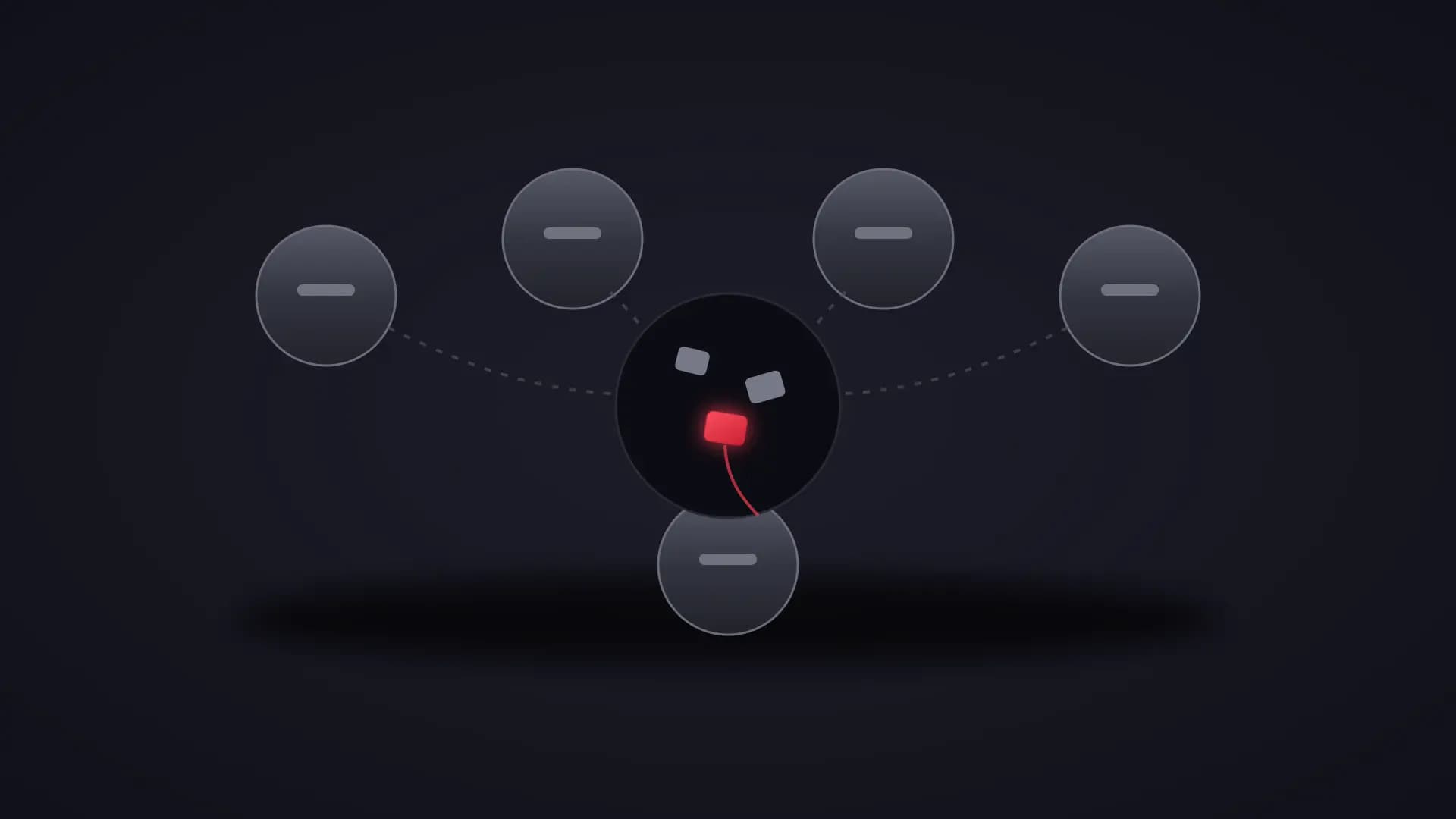
It started with things slipping.
Not catastrophically. Not in ways that cost us clients. The kind of slipping that happens when a growing agency is running on five tools that don't talk to each other. A client request buried in a Slack thread that didn't become a task. A change order that got scoped in an email and never made it into Asana. A project that looked healthy in the sheet and wasn't.
The tools weren't broken. Asana works. Harvest works. Slack works. Google Sheets work. The problem was the space between them. That space is where work disappears.
We decided to close it.
The first version
The first version of Mission Control had one job: keep things from slipping.
We weren't trying to build a product. We were trying to stop losing work. The architecture we landed on was intentionally minimal: a dedicated Mac Mini running always-on infrastructure, an orchestration layer to route work between agents, and a single place where every client, every task, and every deliverable had a record that didn't depend on a human remembering to update it.
We called the agents what they were. Joan handles intake. Every inbound communication classified and routed before a human touches it. Peg is the gate. Nothing moves to execution without validation. Otto runs growth. Hello runs CRM. Atlas runs SEO and measurement. Pulse watches the system and reports what it sees.
Six agents, one Console, one place where work either exists on record or it doesn't.
Within weeks, things stopped slipping. Not because we built something sophisticated. Because we built something with an opinion about where information lives and who has authority to act on it. That opinion, codified in AGENTS.md, in SOUL files, in an escalation architecture that routes ambiguity to a human instead of letting it stall, turned out to be the actual product.
We just didn't know it yet.
What building it taught us
When you build a system from scratch instead of buying one off the shelf, you learn things that the shelf doesn't teach you.
The first thing we learned: the tools weren't the problem. The problem was that every tool required a human to move information from one place to another. Email comes in. Human creates a task. Human estimates effort. Human updates the project. Human logs time. Human reports status. The tools are fine. The humans bridging the tools are the bottleneck.
The second thing we learned: when you replace those bridges with agents, the agents need governance before they need capability. An agent that can act without clear authority boundaries doesn't save time. It creates a new category of problem that didn't exist before. The stress test we ran before production deployment, which surfaced 8 critical fixes across 71 governance documents, confirmed this. Capability without governance is a liability.
The third thing, which took longer to see: every agency we talked to had the same five tools and the same gaps between them. The problem we were solving internally was not a Digital1010 problem. It was the operating condition of every service business running on a stack of disconnected SaaS.
That realization is what turned Mission Control from an internal fix into a product direction.
The insight that changed everything
In April 2026, while re-architecting the skill layer, something became clear.
The way we had built Mission Control, skills as discrete, versioned, composable units of intelligence, was not just a better way to organize an internal system. It was a better way to build any operations platform. Skills that can be swapped, tested, contributed to, and optimized per task are fundamentally more durable than monolithic AI workflows baked into a product.
And underneath all of it, there was a simpler observation: every piece of operational work in an agency starts with an email.
A client sends a request. It's an email. A scope change comes through. It's an email. A new lead reaches out. It's an email. A project needs a status update. It triggers an email. The inbox is not just where communication lives. It is the entry point for the entire operational surface of a service business.
Every other tool in the stack, Asana, Salesforce, Slack, Harvest, exists to process something that arrived by email and model it in a different format. We were building agents to bridge those tools. The cleaner question was: what if the email never had to leave?
What we're building now
The platform that comes out of this isn't Mission Control for Digital1010. It's Mission Control for any agency, any consultancy, any service business running on a disconnected tool stack.
The architecture: email arrives, AI skills classify it by client, project, and urgency. One action converts it to a task with an AI-generated effort estimate that automatically deducts from project budget and timeline. The project health updates in real time. The client sees scope impact. The owner sees profitability impact. The calendar event is created with buffer time. The morning brief surfaces everything that needs action before the day starts, and every action in that brief works without logging in.
The skill layer handles the intelligence: classify-email, mine-email-history, estimate-task-effort, assign-best-teammate, generate-draft-reply, generate-meeting-prep, calculate-project-health. Each skill routes to the optimal model for the task. Classification goes to a fast, cheap model. Complex reasoning goes to a more capable one. Users choose. Or they let the system choose. BYOK at the enterprise tier means they bring their own keys entirely.
This is not a better task manager. It is not a smarter CRM. It is the argument that you should not need either. That six months of email history is more client intelligence than any CRM seeded from scratch. That tasks derived from actual client communication are more accurate than tasks estimated in a planning meeting. That the inbox you already live in is the only interface you actually need.
The category we're creating
The market is moving toward more tools, not fewer. Every AI announcement produces a new point solution. A better way to draft emails. A smarter meeting summary. A faster task creator. The stack gets longer. The gaps get wider.
We are going the other direction.
Tool elimination is the position. Not "we integrate with your stack." Not "we're the AI layer on top of what you have." The argument is that the stack itself is the problem, and that a platform organized around email intelligence makes most of it unnecessary.
That argument was tested internally first. It held. Asana is gone. Harvest is gone. The Google Sheets are gone. The Slack channels that were archiving operational decisions are gone. What replaced them is a system where work either has a record or it doesn't, where scope impact is visible before the work is done, and where the morning brief tells you what needs to happen today without requiring you to check five places to find out.
Where it goes from here
Mission Control was the proof that the architecture works at agency scale. The platform is the same architecture made available to every service business that is losing work in the gaps between their tools.
The first version fixed what was slipping. The next version eliminates the conditions that cause the slipping in the first place.
That is the product. That is what we are building.