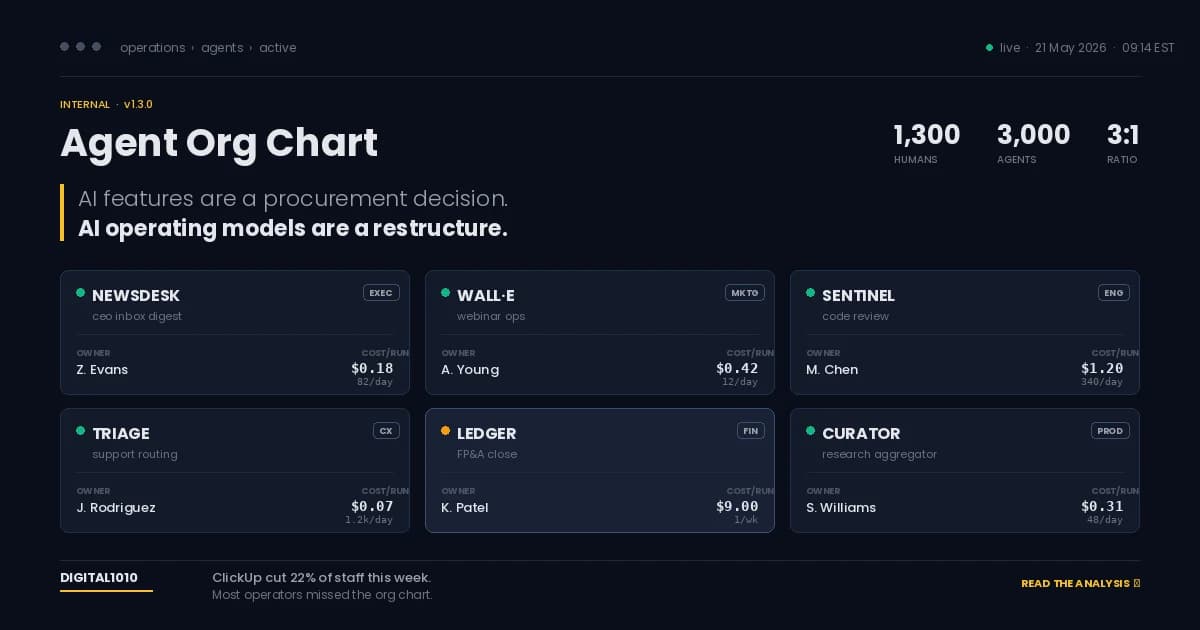
The CEO of ClickUp has stopped reading email. He does not open Slack. He does not check dashboards. An AI agent does all of it, formats what matters into something that looks like a daily newspaper, and chats it to him every morning.
This week that same CEO cut 22% of his staff. He posted the whole memo on X. Read past the headline number and you find what most operators running businesses do not want to talk about.
ClickUp now runs roughly 3,000 internal AI agents against 1,300 employees. A 3 to 1 agent-to-human ratio inside the building. They have an org chart for those agents. Every agent has a name. Every agent has a human owner. The dashboard shows what each one costs to run. One agent costs $9 every time it fires.
That paragraph is the actual story. Not the layoff. Not the ratio. The org chart with names, owners, and unit economics per agent.
AI features are a procurement decision. AI operating models are a restructure. They are not the same company, even if their board decks look identical.
Before you write this off as another AI hype piece, look at the numbers. ClickUp is a $4B SaaS company. Twenty million users on a real product used by Netflix, IBM, and Spotify. Not a demo. Not a thought experiment. They restructured an entire functioning business around agents this year and their CEO posted the receipts on a public timeline. The market will price this. The question is which side of the price you want to be on.
The two categories operators have to choose between
Watch what happens over the next eighteen months. Two kinds of company are about to separate cleanly.
Companies with AI features have ChatGPT licenses. Some teams use Copilot. They added a "summarize this thread" button to their internal tools. They report on AI usage in board decks. Their cost line for AI grows quarter over quarter. Their output per employee does not move.
Companies with an AI operating model have an agent org chart. Named agents with named owners. Unit economics per agent. Guardrails written into agent design. Comp tied to AI-leveraged outcomes. A CEO who does not open his inbox because an agent does it better than he can.
The first category is going to look like the second category in a board deck. They are not the same company. The second compounds faster, ships faster, and costs less per unit of output. The first is paying for tools without changing the operating model around them.
The mechanism for the gap is not technological. It is talent. The best operators, the best engineers, the best marketers will move toward the companies that pay them for AI leverage. Once they leave, the company they left is not recruiting them back. The compounding is in the talent flywheel, not the model itself.
If your CFO can see the AI line item growing and cannot see the leverage on the other side, you are in the first category. You have a procurement problem dressed up as a transformation.
What actually happened at ClickUp
Per Fortune's May 18 feature and Zeb Evans' own X memo posted this week, ClickUp made the agent shift the central operating decision of 2026. Not a side feature ship.
Evans installed a policy earlier this year: employees cannot ping him directly. They have to first work through an AI agent trained to stand in for him. Only after working the problem with the agent can a human escalation happen. He admits this was jarring for his 1,300 employees. He did it anyway because he wanted to force the company to default to agents instead of treating them as optional.
Roughly 3,000 agents now sit embedded in workflows across departments. Marketing has agents that scale webinar programs from one per month to six. Engineering has agents that draft and review code. Operations has agents that manage scheduling and coordination. The agents are the workflow. Humans direct them, review their output, intervene when something needs judgment.
Evans framed the engineering shift in his memo this way: the 10x engineers, the ones who can orchestrate, architect, and review, are becoming 100x engineers. They are not writing code. They are directing agents that write code. The skill is judgment.
Every employee at ClickUp is now a manager of agents. The skill set is shifting from execution to direction, judgment, and taste.
Evans also gave a definition of "AI native" in the memo that is sharper than anything a consultant will produce this year. He wrote: "You must create enough disruption so that old systems are deprecated entirely. If there's any definition for AI native, that's what it is."
Read that twice. AI native is not augmentation. It is replacement of the legacy workflow. The old workflow is dead, not optimized.
The piece nobody is copying yet
Here is the part of the ClickUp story that should change how you think about building.
They have an org chart for their agents. Every agent has a name. Every agent has a human owner who is responsible for making sure it works as intended. When the agent needs information or hits an edge case, it messages that owner. The dashboard shows what each agent costs to run.
Most companies skip this. They bolt a copilot into Slack, license a couple of agent platforms, and declare themselves AI-forward. They cannot answer: who owns this agent's outcome, what is it allowed to do, what does it cost to run, and what happens when it produces something wrong?
ClickUp can. That is the structural difference.
Two design choices in their setup that operators should steal. The first is guardrails as a first-class concept. ClickUp agents cannot delete anything. They cannot merge code to production. The constraints are not afterthoughts. They are baked into what an agent is allowed to be. If your agents can do irreversible damage and you have not designed the constraint, you do not have an AI operating model. You have a liability.
The second is cost visibility as a daily metric. ClickUp knows what every agent costs to run because the costs of agent fleets do not behave like SaaS seat licenses. Some agents are cheap and run constantly. Some are expensive and run rarely. If you cannot see the unit economics of your agent fleet, you cannot optimize it, and you cannot make a case to your CFO about why agent spend is replacing headcount spend on a positive ROI basis.
The comp model is the part that will not get copied
ClickUp did something this week that most companies will fail to copy because it costs money and requires committed leadership. The headcount cut announced this week is not the story. The comp redesign attached to it is.
Per Zeb's memo: "Most savings from this change will flow directly back into the people who stay. We'll be introducing million-dollar salary bands. If you create outsized impact using AI, you'll be paid outside of traditional bands."
Million-dollar salary bands. Pay outside traditional ranges if you create outsized impact with AI.
Most companies are signaling, implicitly or explicitly, that AI is a threat to their employees. ClickUp is signaling that AI is your leverage and you will be paid more for using it well. That is a different culture lever. It is also a wildly different recruiting lever for the talent who can actually pull this off.
Evans put it directly: "In a world where your best people create 100x impact, you can't afford to lose them."
Most CEOs will copy the headcount cut. Almost none will copy the bands. In eighteen months you will see which ones still have their best people.
The great reckoning
Zeb calls what is coming "the great reckoning of AI coding." He is right that it is coming. He may also be early on it, and that is a real risk that needs naming.
A 2026 Mercor study referenced in the Fortune piece evaluated agents from top-tier models on 480 workplace tasks. Every agent failed to complete most of its assigned duties. KPMG's Q1 2026 Global AI Pulse report found that 22% of businesses are exploring agents and 14% are deploying them, but only 9% say they are orchestrating multiple agents across workflows.
Most companies are still at the demo stage. Very few are at the operating stage. ClickUp is ahead, and the question is whether being ahead pays off or breaks something visibly before the rest of the market catches up.
The honest read is both can be true. Some of ClickUp's 3,000 agents will get pruned. Some workflows will get pulled back to humans because the agent version produced low-quality output that nobody caught. Some agents will get more expensive than they are worth and quietly retired. That does not invalidate the model. It means the operating loop has to include "agents that are not working get retired" as a normal management activity, the same way underperforming sales reps get coached out.
Zeb framed the choice in his memo as two options: wait for this to play out gradually in the market, or be honest about what you see and act proactively. He picked the second. The companies that pick the first will not survive the talent flywheel.
The risk is real. The risk of doing nothing is bigger.
What to do this week if you are operating a business
Three actions that do not require a $4B valuation.
I guarantee you have AI usage in your company you do not know about. Individual tool subscriptions, Zapier flows, custom GPTs, browser extensions, shadow IT. Inventory it. Note who owns each one. Note what happens if it breaks. If you cannot answer those questions for the agents you already have, you cannot scale to ten more.
Next, pick one workflow and rebuild it as an agent workflow with an owner. Not a feature. A workflow. Define inputs, constraints, outputs, the human review step, and the named owner on the hook for the agent's behavior. Measure cost to run against time saved. This becomes the template for every subsequent agent you bring online.
Then decide what your comp model says about AI leverage. You do not have to copy million-dollar bands. You do have to decide whether your raises, bonuses, and promotions reward employees who use AI to multiply output, or whether they reward employees who do the work the old way and look busy. Whichever one your comp model rewards is what you will get more of.
The gap is widening
AI features are a procurement decision. AI operating models are a restructure.
In eighteen months you will be able to tell which companies made the call. They will be doing the work of three. They will be paying their best people outside the band. They will have an org chart you can show a board.
The rest will have a pile of AI licenses and the same headcount they had this quarter.
Which chart do you want to be holding in eighteen months?
Digital1010 is the AI-native operating partner for enterprise teams in healthcare, facilities management, legal, MSPs, and hospitality. We build the agent infrastructure that backs the org chart. If you want a practitioner's read on where you actually are, reach out here.