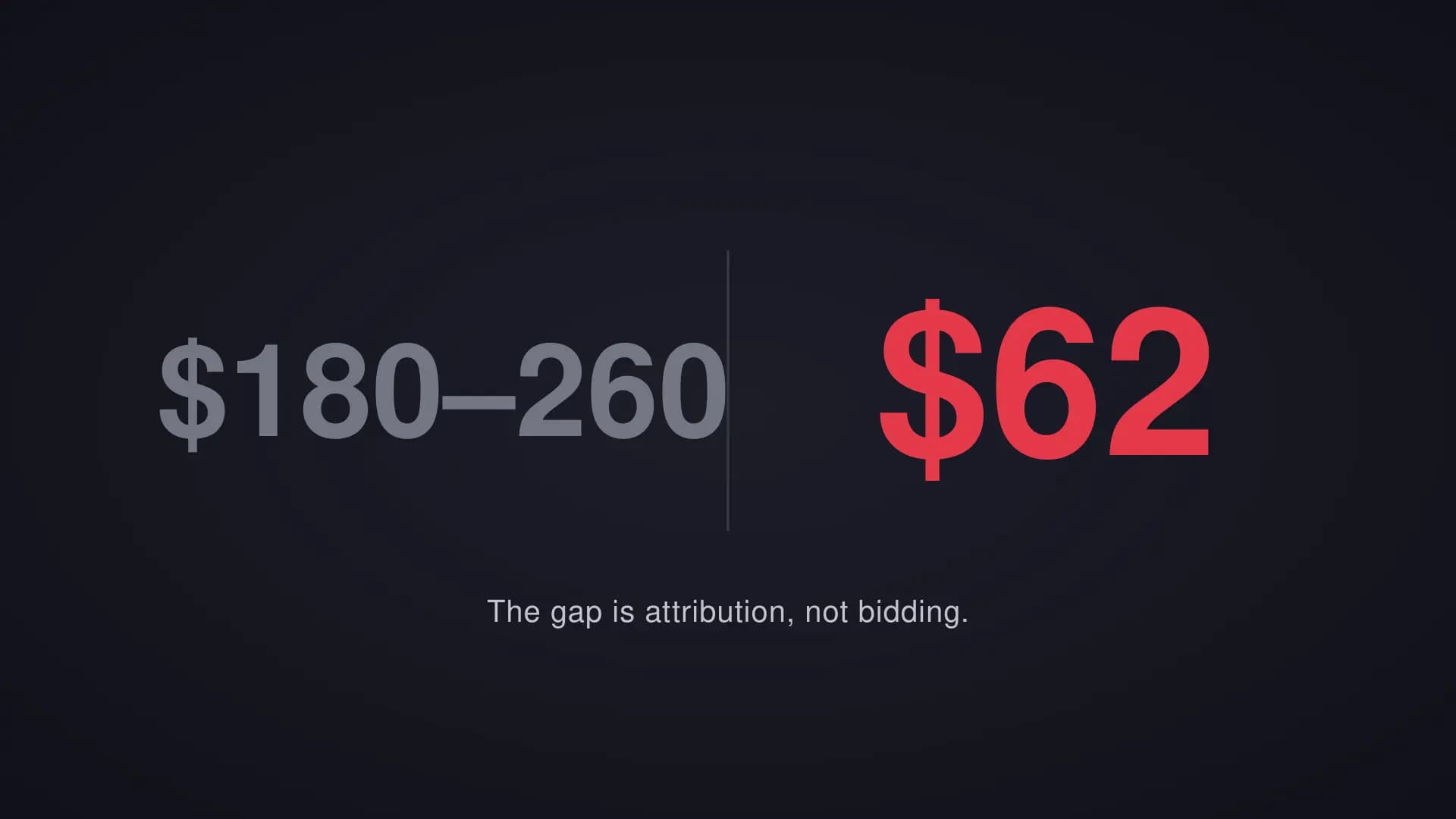
The Wednesday afternoon we figured out what was actually wrong with our family law client's Google Ads account, the answer wasn't anywhere on the dashboard. Spend was steady. Click cost was reasonable. Conversion rate on form submissions looked acceptable. The agency that ran the account before us would have shipped a clean monthly report and renewed.
We pulled the closed-case data out of the firm's case management system and reconciled it against the Google Ads conversion log. Of the 184 leads Google Ads was reporting as converted in the prior 90 days, 31 had become actual signed cases. The bidder thought it was performing at $94 cost-per-lead. The reality was $558 per closed case. Google's algorithm had spent three months learning to find more form-fillers and fewer buyers, because nobody had ever told it which leads turned into clients.
We wired offline conversion imports from the case management system back into Google Ads, weighted by case value. We restructured the asset groups by practice area. We cleaned the negative keyword list at the account level. Within 90 days, the blended cost-per-lead on closed cases was $62.79. The state average for comparable family-law terms is between $180 and $260 depending on metro and time of year. We'd opened up a structural gap, not by being clever, but by giving the bidder the data it needed.
This guide is the operational version of how we run paid search for law firms. It consolidates everything we used to publish across six separate posts on PPC tactics, ad strategy, and Google Ads management. The reason we collapsed them into one piece: the work doesn't break apart cleanly. PPC for law firms is a single operating discipline, not a bundle of tactics.
Why most legal PPC underperforms by 2-3x
The pattern is consistent across every legal Google Ads account we audit. Three structural problems compound, and the result is paid programs that look fine in monthly reports and bleed money against actual case value.
Problem one: the bidder is optimizing against form fills, not closed cases. Google's automated bidding (Maximize Conversions, Target CPA, or Performance Max) only optimizes against the conversion signal it's given. If the conversion event is "form submitted on contact page," the bidder learns to find more form-submitters. Spam, retargeted bounces, unqualified inquiries, all of these count as conversions. The bidder finds more of them. The reported CPL stays low. The actual CPL on closed cases is 3-4x higher because most of the form-fills were never going to be clients.
Problem two: campaigns and asset groups are structured around match types instead of practice areas. Most legal accounts I audit are organized like "Exact Match Campaign," "Phrase Match Campaign," "Broad Match Campaign." This was best practice in 2017. It is structurally wrong in 2026. The bidder learns nothing about practice intent from this structure because divorce queries, custody queries, and probate queries are mixed into the same asset groups. Each practice area has different decision criteria, different lead values, and different intake patterns. Mixing them dilutes every signal.
Problem three: intake operations leak the leads the paid program produces. This is covered in detail in the marketing strategies piece, so I'll keep it short here. Industry-benchmark intake conversion runs at 22 percent of raw inbound to scheduled consult. The operations we've rebuilt with our family law client run at 36 percent. The 14-point gap is the difference between a paid program that's "working" and one that's actually delivering ROI to the firm.
Each of these three problems is fixable. None of them require firing the agency. They require the agency to be doing different work.
The operational stack we run
What follows is the actual operational stack we run on legal Google Ads accounts, presented as a sequence so it can be implemented or audited without missing pieces.
Layer one: Performance Max as the format, configured properly
Performance Max is Google's automated format that combines search, display, video, discovery, and shopping into a single AI-driven campaign. For law firm clients, it has been the single biggest unlock on cost-per-case, but only when configured properly. Misconfigured PMax is worse than a clean Search campaign because the format expands the surface area of bad decisions when the conversion signal is wrong.
The right configuration:
- One PMax campaign per practice area. Family law is one campaign. Estate planning is another. Personal injury is another. Each has its own asset groups, its own creative, its own landing pages, its own intake routing. The bidder learns each practice area as a distinct intent pattern instead of cross-contaminating them.
- Asset groups by sub-practice within each campaign. Family law splits into divorce, custody, paternity, and modifications as separate asset groups. Each gets its own headlines, descriptions, images, and final URLs. The bidder learns which sub-practice intents respond to which creative.
- Final URL expansion turned off. PMax can crawl the firm's site and generate landing pages from any URL it finds, which produces unpredictable results in regulated verticals like legal. We pin specific final URLs to each asset group and disable URL expansion entirely.
- Audience signals as inputs, not constraints. Provide PMax with custom segments based on ideal-client patterns (recent searches for the practice area, demographic indicators, prior-engagement signals). These signals seed the bidder; they don't restrict it. The bidder will still test outside the seeded audiences but starts from a better baseline.
- Brand exclusions configured at account level. Brand exclusions prevent PMax from cannibalizing the firm's branded search campaign. Without this, PMax bids on the firm's own name and steals credit from organic traffic that would have come anyway.
Layer two: offline conversion imports against case management
This is the single biggest lever. Offline conversion imports (OCI) feed closed-case data from the firm's case management system back into Google Ads, attributed to the click that produced the lead, weighted by case value.
The mechanism: when a lead enters the firm's case management system, the system records the GCLID (Google Click Identifier) that drove the original session. The GCLID is captured by a small JavaScript snippet on the contact form and stored in the lead record. Daily (or hourly), an export job sends a CSV of newly-closed cases back to Google Ads via the Conversions API, with the GCLID, the conversion type, the conversion value, and the conversion date.
The result: the bidder stops optimizing against form submissions and starts optimizing against closed cases. The signal it learns from is now revenue, not lead volume. CPL on closed cases drops 40 to 60 percent within 90 days of the OCI feed turning on.
We run this inside Hello Automations for legal clients because the GCLID capture, the case management API integration, and the daily upload schedule all need to live in one operational system. Implementing it from scratch is a real engineering project, typically 2-3 weeks of work for a developer who's done it before, longer for one who hasn't. Once it's running, it's the foundation everything else builds on.
Layer three: negative keyword discipline
The number of paid-search wastes the legal industry tolerates is a wonder. Match types that pull in queries like "free divorce lawyer Reddit," "pro bono custody attorney," "law school admission requirements", none of which are buyer intent for a paid family law practice. We've taken accounts running at $148 CPL and dropped them to $98 in three weeks of negative keyword work alone, before any other optimization fired.
The discipline:
- Weekly negative keyword review at the account level. Pull the search terms report from the prior week. Flag every query that didn't produce a real lead and add it to the account-level negative list. The list grows to several hundred negatives within the first quarter and stabilizes after that.
- Match types audited monthly. Broad match without proper signal data produces unpredictable results. Phrase match is usually the right default for legal queries. Exact match catches the highest-intent terms but at lower volume. The mix needs to be re-audited monthly because Google changes match-type behavior on a quarterly basis.
- Question keywords and information queries excluded. "What is family law" is not a buyer query. "How do I file for custody" is not a buyer query. These belong in the SEO content program, not the paid program. Adding them as account-level negatives keeps the bidder focused on transactional intent.
Layer four: landing pages that match the asset group
Most legal accounts run all paid traffic to a single contact page or to the homepage. The bidder cannot evaluate which landing page experiences convert best because there's only one. The result: PMax can't optimize ad-creative-to-landing-page fit, and the firm loses 10-20 percent of conversion rate that would have come from proper page fit.
The fix: every asset group gets its own landing page. The landing page mirrors the asset group's practice intent. Divorce gets a divorce landing page. Custody gets a custody landing page. Paternity gets a paternity landing page. Each landing page:
- Speaks to the specific intent of the asset group, not the firm's full service offering
- Has a single CTA tied to the right intake routing for that practice
- Includes social proof specific to the practice (testimonials about divorce cases on the divorce page, not generic five-star quotes)
- Loads in under 2 seconds on mobile (Core Web Vitals at Good)
- Has schema markup as
LegalServicewith the rightserviceTypeand pricing structure
The lift from proper landing page fit on top of properly-structured asset groups is meaningful, typically 15-25 percent additional conversion rate. Combined with the offline conversion uploads, this is where the cost-per-case math really separates from the industry baseline.
Layer five: intake operations that don't leak
Already covered in detail in the marketing strategies piece, so I'll keep this brief. The summary: every dollar that comes through the paid program runs through the intake funnel. If the intake funnel converts at 22 percent (industry baseline), the firm captures 22 cents of every dollar. If the funnel converts at 36 percent (operational discipline), the firm captures 36 cents. The marketing spend that produced the leads doesn't change. The cents on the dollar do.
What we change at the intake layer for legal clients:
- 90-second qualification script trained on the firm's actual practice areas
- Same-day or next-day consult availability for urgent matters (divorce filings, restraining orders, time-sensitive estate matters)
- After-hours coverage by a legal-specialized answering service with calendar access
- SMS confirmation via Twilio replacing the form-fill autoresponder email
- "Speak with an attorney now" callback option on every consultation page
This is the lever that makes the paid program ROI sustainable. Without it, every CPL improvement at the bidder layer gets diluted at the intake layer.
What it costs to run this properly
I'll be specific about budget because this is where the agency conversation goes off the rails. The numbers below are approximate and depend on market, practice area, and account history.
Implementation work to set up the operating stack: $8,000 to $15,000 one-time. This includes account restructure, OCI feed engineering against the case management system, asset group rebuild by practice area, landing page builds for each asset group, intake script and SMS workflow. The work spans 3-5 weeks depending on case management complexity.
Monthly management once running: $2,500 to $5,500 per month. Weekly negative keyword review, monthly asset group optimization, monthly landing page A/B tests, quarterly creative refresh, ongoing OCI monitoring, monthly reporting against closed-case data.
Media spend: entirely separate from agency fees. Legal accounts we run typically allocate $5,000 to $40,000+ per month in actual ad spend depending on practice mix and market competitiveness. The ratio of fees to spend matters less than the ratio of fees + spend to closed-case revenue.
Total minimum to do this properly: about $30,000 in setup plus $30,000 to $66,000 a year in ongoing fees, with media spend separate. That's a meaningful budget. It is also dramatically below the industry's best-known agencies' six-figure annual fees and produces structurally better results because the work is the actual operational work, not a rebranded reporting exercise.
If your current paid program is running at half this scope and getting half these results, that's roughly the gap you'd be closing.
How to know if your current paid program is doing this
Three diagnostic questions for whoever runs your law firm's Google Ads.
"Show me the offline conversion upload feed." If they don't have one, your bidder is optimizing against form fills, not cases. Everything downstream of that is on a broken foundation.
"How many asset groups exist per campaign, and how are they structured?" If the answer is "one asset group per campaign" or "asset groups by match type," the structure is wrong for legal. Practice-area asset groups are the table stakes for operating PMax in legal verticals.
"What's the search-term report from last week look like, and which terms got added to negatives?" If they can't answer immediately or the negatives list hasn't grown, the weekly hygiene isn't running. The CPL inflation from this alone is 12-18 percent on most accounts I audit.
If any of those three questions comes back weak, the agency isn't running the operational stack above. They're running an account, not optimizing one. Different products.
Why this article consolidated six earlier posts
Anyone landing here from an old /blog/ URL is probably looking for a specific PPC tactic, Google call-only campaigns, picking the right PPC agency, how law firms use Google Ads, optimizing AdWords, personal injury Google Ads strategies. We had a separate post on each of those over the last several years.
We collapsed all of them into this one piece for one reason. PPC for law firms is not a tactical bundle. It's an operating discipline. Reading six tactical posts will not produce the cost-per-case results above. Implementing the operating discipline above will. The right framing for the firm asking "what should we do about our paid program" is "is the operating discipline running." Not "are we using the right tactics."
The redirect from each of the six older URLs lands here. The operational version is below.
A 60-day implementation plan
If a managing partner asked me what to do for the next two months, here's the answer.
Days 1 to 14: instrumentation. Install GCLID capture on every contact form. Wire offline conversion API integration with the case management system. Configure the daily OCI feed to Google Ads. Confirm the feed is flowing with test conversion records. This is the foundation; nothing else works without it.
Days 15 to 30: account restructure. Audit existing campaigns and asset groups. Rebuild by practice area. Configure brand exclusions. Set up audience signals. Build new landing pages for each asset group. Migrate spend from old structure to new structure with a 30-day overlap so historical learning isn't lost.
Days 31 to 45: intake reset. Audit current intake conversion rate. Train the intake team on the new script. Activate after-hours legal-specialized answering service. Wire SMS confirmation through the CRM. Add callback option on every consultation page. Measure intake conversion weekly.
Days 46 to 60: optimization cycle. Weekly negative keyword review begins. Monthly asset group performance audit begins. Landing page A/B tests start running. The OCI feed has 30 days of data flowing, so the bidder is now optimizing against actual case value. Compare CPL on closed cases at day 60 to baseline at day 0.
By day 60, the operational stack is running. The CPL trend is visible against the baseline. The firm has a paid program that's actually optimizable, instead of a paid program that produces monthly reports.
If your firm is running paid search and any part of the operating stack above isn't in place, the next step is a 30-minute audit conversation. We do this for two to four firms a quarter as a free entry point. The output is a punch list specific to your account. If we're the right shop to do the work, we'll scope it. If a contractor or in-house can handle it, we'll point you there.